From Concept to Customer: The Changing Face of App Development
A business may have an idea for an app, a capable development team and enough budget to build it.The app can still fail if it solves the wrong problem confuses users or fades from attention after launch.
That is why the modern App Development Process looks less like a line from "idea" to "app store" and more like a continuous cycle of validation, building, learning and improving. The goal is not simply to release software. It is to create a product that people choose to use and return to.
Why Apps Are Now Business Systems, Not Digital Accessories
For companies an app used to be a smaller version of their website: a menu, a contact form, a catalogue or a landing page. That approach no longer matches how customers behave.
A café may use its app for loyalty rewards and advance orders. A clinic may allow patients to book appointments, receive reminders and access reports. A fitness studio may combine class bookings, memberships, workout plans and payment history in one place. In each case the app reduces friction. Gives the business a direct relationship with the customer.
This is the value of mobile app development for businesses: it turns scattered customer interactions into a clearer more measurable experience. By relying only on walk‑ins, phone‑calls or social media messages a business can guide users toward booking, purchasing, renewing or referring others.
The shift also changes what "success" means. Downloads alone are a measure. A useful question is whether the App Development Process helps customers complete something valuable, book a service, reorder a product, track progress or get support without needing help.
What Has Changed in the App Development Lifecycle
The traditional App Development Process often treated launch as the finish line. Today's launch is closer to the beginning of the product’s important phase.
The Modern App Development Process usually moves through stages: discovery, planning, design, development, testing, release and ongoing improvement. These stages overlap in practice; a usability test may send a team back to design while early analytics may change the development roadmap.
| STAGE | CORE QUESTION | PRACTICAL OUTPUT |
|---|---|---|
| Discovery | Whose problem are we solving? | User needs, business goals, feature priorities |
| Planning | What must the first version include? | MVP scope, budget, technology direction |
| Design | How will people use it? | Wireframes, prototypes user flows |
| Development | How will it work? | End, back end integrations |
| Testing | Will it work reliably? | Bug fixes, performance checks, user acceptance testing |
| Launch | How will people start using it? | Store listing, onboarding, analytics |
| Growth | What should improve next? | Updates, retention work new features |
The important change is not the number of stages. It is the mindset behind them: every stage should reduce uncertainty before more money and time are invested.
Start With the Customer Problem, Not the Feature List
Many app projects begin with a wish list: chat, notifications, loyalty points, payment integration, AI recommendations and an admin dashboard. The problem is that features do not create value by themselves.
A better starting point is to pick one job for the customer. For example a dental clinic might decide: "Patients should be able to book, reschedule and receive reminders without calling reception." That statement immediately narrows the scope. Makes success measurable.
During discovery useful questions include:
- What problem costs customers time, money or effort today?
- Which existing process creates the complaints?
- What action should the app make easier: booking, buying, learning, tracking or support?
- How will the business know the app is working?
- What is the smallest version that can prove the idea?
Custom app development becomes valuable here. A custom product can reflect the company’s workflow, what customers expect and the brand instead of forcing the business into a generic template. The trade‑off is an upfront cost so the business case must be tied to measurable outcomes, not just the wish to "have an app.”
Design for the First 60 Seconds
Users rarely give an app time to prove itself. If onboarding is confusing, the value unclear or the first action difficult they may leave before experiencing its benefits. Good design is not decoration. It is the process of removing obstacles between intent and action.
For example a yoga studio app should make the next class easy to find and book within a taps. A home‑services app should show availability, service area, price expectations and a clear way to request help. A retail app should make repeat ordering faster than visiting the website.
- Show the core value early: Users should understand what the app does before being asked to create an account.
- Reduce required steps: Every additional field, permission request or screen adds friction.
- Design for real‑world use: People use apps while travelling, waiting, working or multitasking.
- Make errors recoverable: Clear messages and simple recovery paths protect trust when something goes wrong.
- Test with users: Internal approval is useful but customer behaviour is more reliable evidence.
A simple test works here: give someone who has never seen the app a phone and ask them to complete the main action. If they hesitate to ask questions or need help the problem is usually in the flow not in the user.
Build the Right Version First
The strongest app projects do not try to build everything at. They release a focused viable product, learn from real usage and expand only where evidence supports it. A restaurant might begin with ordering, loyalty rewards and order‑status updates. It does not need a rewards engine, social feed or augmented‑reality menu in version one. Once customers show demand the business can add features with confidence.
This approach also affects technology choices. Cross‑platform development allows one codebase to serve both iOS and Android which can reduce engineering time and maintenance overhead compared with maintaining native apps. Industry coverage commonly estimates time savings of 30-40% for many cross‑platform projects though the right choice still depends on performance needs, device features, budget and long‑term plans.
Low‑code and no‑code tools can help teams validate an idea quickly for internal tools or early MVPs. They are not automatically the best answer for every product. Complex integrations, strict security needs, custom user experiences and large‑scale performance requirements may still justify a custom build.
Testing Protects More Than Functionality
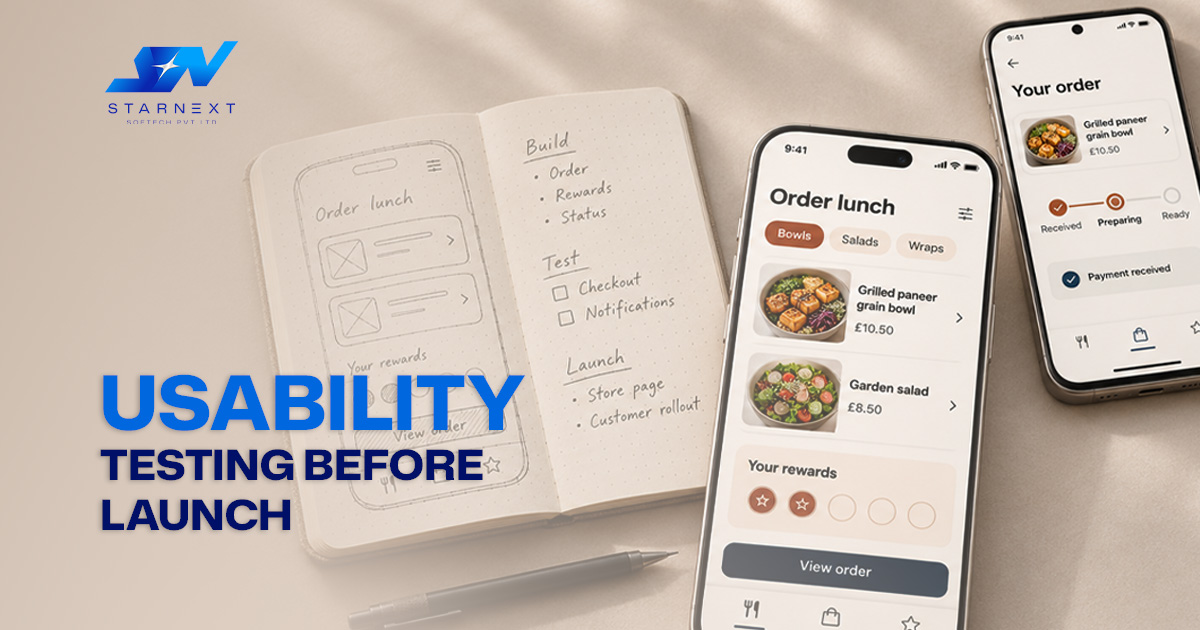
Testing is often treated as the technical checkpoint. In reality it protects the customer relationship.
An app that crashes during payment fails to send an appointment reminder or breaks after an operating‑system update creates frustration. Users may not complain; they may simply stop using it.
- Core user journeys, such as signup, booking, payment and support must be reliable.
- Device and operating‑system compatibility.
- Speed, stability and offline behaviour.
- Security, privacy permissions and data handling.
- Accessibility, including text and usable navigation.
- Real‑user testing, before public release.
The purpose is not to eliminate every issue. It is to make sure the important customer actions work dependably.
Launch Is a Marketing Moment, Not the End
An app store listing is a product page. App needs a name, a benefit‑focused description, quality screenshots, a short preview video where useful and honest answers to common questions. Visibility does not end at the store. Businesses should plan how customers will discover the app:
- Add app download links to the website, email signatures, invoices and packaging.
- Train frontline staff to explain the app’s benefits.
- Use in‑store QR codes for restaurants, salons, clinics, gyms and retail locations.
- Run campaigns around a specific reason to download, such as exclusive booking access or loyalty rewards.
- Track installation sources, activation, repeat use and conversion not just downloads.
A launch plan should answer one question: Why would an existing customer install an app today?
Current Mobile App Development Trends That Matter
Mobile app development trends are shaping how businesses approach product decisions. AI is becoming part of the product experience. Apps increasingly use personalization, recommendations, conversational support and task automation. The useful question is not "Can we add AI?" but "Where would intelligence genuinely save the user time or improve a decision?”
Cross‑platform development is now a default. For business apps frameworks that share code across iOS and Android make it easier to launch faster and maintain one product roadmap. Privacy and security need attention. Customers increasingly notice data collection, weak permissions and unclear privacy practices. Security should be part of the architecture, not a checklist item.
Performance and offline capability matter. Users expect apps to respond quickly on unstable connections. Design, efficient data handling and edge processing can matter for delivery, field‑service, travel, healthcare and logistics apps.
Low‑code is expanding beyond prototypes. Apps can accelerate tools and early validation but teams should assess scalability, integration needs and long‑term ownership before committing.
Common Mistakes That Turn Ideas Into Apps
The most expensive app problems usually appear before coding begins.
- Building without a defined business outcome: If nobody knows whether the app should increase bookings, retention orders or support efficiency every feature debate becomes subjective.
- Copying a competitor blindly: A feature that works for a marketplace may be unnecessary for a local service business.
- Ignoring existing workflows: Staff may avoid an app that creates administrative work.
- Treating launch as completion: Without updates, performance monitoring and customer feedback even a good app loses relevance.
- Collecting data without purpose: More data is not automatically better; it must support a clear product decision.
- Choosing technology before understanding the product: The right stack depends on users, integrations, budget and future plans.
These mistakes are avoidable. Only if the business is willing to challenge its own assumptions early. That is usually uncomfortable. App is also far cheaper than rebuilding an app after launch.
What Businesses Should Do
Start smaller but think longer term.
- 1. Define one customer problem solving.
- 2. Identify the action the app should make easier.
- 3. Create a first release rather than a feature‑heavy version.
- 4. Test the journey with real users before launch.
- 5. Measure behaviour after release: activation, repeat use, conversions, support requests and retention.
- 6. Use those results to decide what deserves investment next.
The businesses that benefit most from apps are not necessarily those with the largest budgets. They are the ones that treat the app development process as a way to remove friction, build trust and create a reason for customers to return. An app becomes valuable when the app moves beyond being a brochure. Done well, the app becomes part of how a business serves customers. How customers choose to come back.
Final Thoughts
The real shift in app development is not that businesses need technology. It is that businesses need ideas about what apps should work to do. An app should not exist simply because competitors have an app or because a business wants a digital presence. An app should make a specific customer task easier whether that task is booking an appointment, placing an order renewing a membership requesting service or getting support.
The useful apps are built around a customer problem. They start with a first version and then get better using real feedback. Many businesses that treat app development as a one‑time project end up keeping an app nobody uses. Businesses that treat app development as a decision are far more likely to see benefits such as keeping customers more repeat orders, smoother operations and more customer trust.
If you are planning mobile app development for businesses. It is best to begin with the customer journey of a list of features. Define the problem, build only what is needed to test the app, measure what happens after the app launches and improve the app based on evidence. That approach turns an app from an accessory into a practical tool.