GEO vs Traditional SEO: How to Prepare Your Business for AI Search Discovery
A business can rank well for a keyword and still be absent when someone asks an AI assistant "Which provider is best for a first-time buyer?" or "Compare the most reliable payroll services for a 20-person company."
That gap is why Generative Engine Optimization has become a strategic discussion. Traditional SEO was built around earning visibility in a list of search results. AI search often produces a synthesized answer, pulls supporting sources and may reduce the number of pages a user needs to visit before forming an opinion.
The practical question is not whether SEO is finished. It is whether your website, brand information and reputation give an AI system clear credible evidence to include you in the answer.
Google's Position: Good SEO Is Still the Foundation
There is a temptation to treat GEO as a technical trick: add a special file, split every page into tiny "AI-ready" blocks or publish dozens of pages for every possible prompt variation. That is not a strategy.
Google's guidance is direct: there are no requirements or special optimizations needed to appear in AI Overviews or AI Mode. A page must be. Eligible to appear with a Search snippet and established fundamentals still apply:crawlability, clear internal linking, helpful people-first content sound page experience and important information available in text.
Google also says businesses do not need AI markup, llms.txt files, artificial "chunking," or rewrites designed only for AI systems. Structured data remains useful for its established SEO purposes, such as rich-result eligibility. There is no special schema type that guarantees AI-search inclusion.
That does not make GEO meaningless. It clarifies where the work belongs: SEO provides the retrieval foundation while GEO improves answer-readiness. The goal is to give users and search systems an evidence-backed understanding of what a business does, who it helps and why it is relevant.
Traditional SEO Earns Rankings; GEO Earns Inclusion in Answers
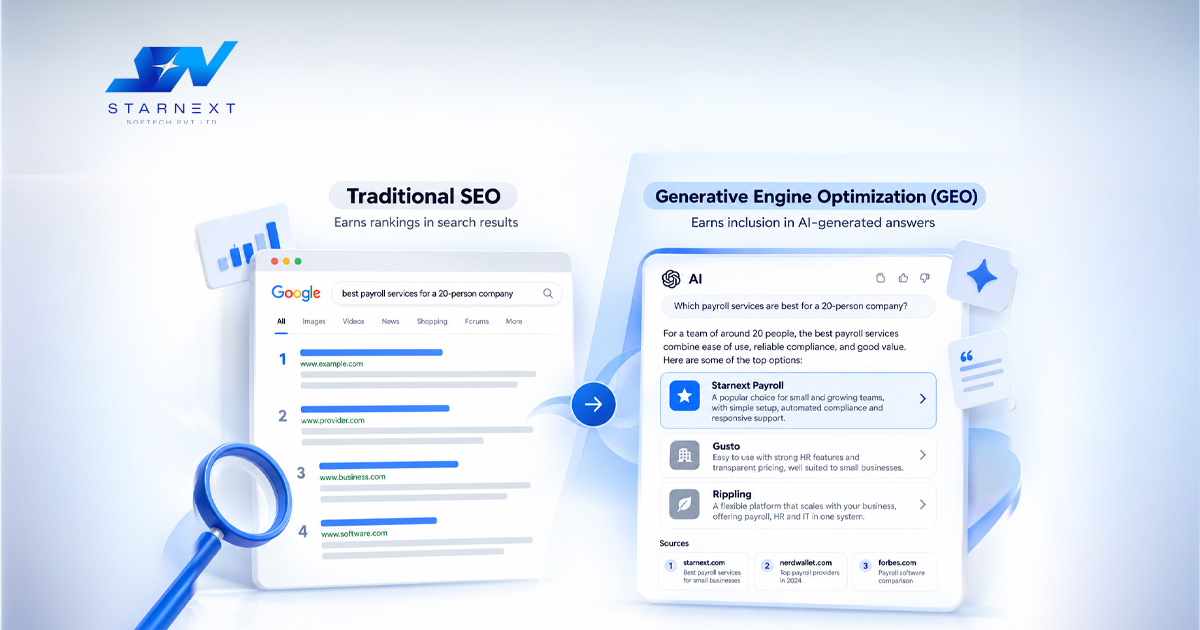
Traditional SEO aims to help a page appear prominently when a person searches Google or another search engine. It typically focuses on rankings, technical accessibility, content relevance, links, user experience and conversion after the click.
Generative Engine Optimization works toward a related but different outcome: increasing the likelihood that a generative search experience retrieves, understands, cites or accurately mentions a brand while answering a user's question.
The distinction matters because AI search journeys are often broader than one keyword. A person searching " CRM for a growing architecture firm" may receive a response that weighs integrations, pricing model, onboarding complexity, security, user reviews and industry fit. The system may effectively conduct related searches before composing its answer.
Google describes this as "query fan-out": AI features may issue searches across subtopics and data sources to build a more complete response. That creates opportunities for useful specialist content to surface but also more ways for a vague or poorly documented business to be overlooked.
| DIMENSION | TRADITIONAL SEO | GEO / AI-SEARCH PREPARATION |
|---|---|---|
| Main visibility outcome | Ranking and click-through from search results | Inclusion, citation, mention or recommendation within a synthesized answer |
| Typical query | "accounting software for small business" | "What accounting software suits a UK agency with project billing?" |
| Core asset | An optimized useful landing page or article | A consistent body of evidence: pages, clear entity data, proof, reputation and third-party validation |
| Success measurement | Rankings, impressions, clicks, leads, revenue | AI-feature traffic, cited or mentioned presence, assisted conversions, branded search growth and lead quality |
AI Search Changes the Content Businesses Need to Publish
The content-production model rewarded volume: one page per keyword variation, lightly edited templates and broad articles written to occupy a topic. That approach was already weak for readers. AI search exposes the weakness because generic information gives a system reason to use one source over another.
A financial adviser for example should not stop at a page titled "Retirement Planning Services." That page needs to establish who it serves where it operates, which planning situations it handles, how its advice process works, relevant qualifications, fees or fee principles, risk disclosures and useful answers to the questions clients ask before booking a meeting.
The goal is not to write for a machine. The goal is to remove uncertainty for a prospect.
Publish Evidence, Not Just Assertions
"Trusted," "expert," and "leading" are claims. They become meaningful when supported by evidence.
For a B2B cybersecurity firm stronger evidence might include an incident-response framework, an anonymized case study showing the business problem and decision process, technical documentation named leadership credentials, a realistic implementation timeline and clear explanations of where the service's not a fit.
That material helps a buyer evaluate the business. It also gives search systems precise information to connect with detailed questions. Google's current guidance emphasizes -commodity content: work with a unique point of view or first-hand knowledge rather than a recycled summary of information already available online.
Organize Pages Around Decisions Not Keyword Variants
A customer rarely searches in one step. Someone evaluating a home-renovation company may begin with design ideas then ask about planning permission, compare materials, check service areas, seek proof of workmanship and finally request quotes.
- Service pages should define scope, process, location coverage, timelines, exclusions and next actions.
- Comparison pages should explain trade-offs honestly including when an alternative may be more suitable.
- Guides should answer pre-purchase questions with expert detail.
- Case studies should show context, approach, limits and outcomes than only polished before-and-after claims.
- About and contact pages should make ownership, expertise, locations and ways to engage unmistakably clear.
This is useful for search and makes a brand easier to represent accurately in a generated response.
Entity Clarity Is the Bridge Between SEO and GEO
AI systems do not encounter a business through its homepage title tag. They encounter signals across web pages, profiles, reviews, news coverage, directories, social media platforms, videos and mentions by organizations.
For that reason entity clarity matters. A business should make it easy to answer questions consistently:
- What is the company's exact name?
- What products or services does it provide?
- Which audience, sectors and locations does it serve?
- Who are its founders, experts or spokespersons?
- What makes its offering distinct?
- Where can customers verify its claims?
For product-led businesses this includes maintaining accurate Google Business Profile and Merchant Center information where relevant. Google notes that business and product details can support visibility in AI responses as well as regular Search results.
Consistency is not about submitting a business to hundreds of low-quality directories. It is about ensuring that high-value sources do not contradict one another. A clinic with opening hours, an agency with unclear service positioning or a software company with outdated pricing creates friction for both people and systems.
A Practical GEO Preparation Plan
1. Fix the Search Foundations First
Audit crawlability, indexing, internal links, mobile usability, page speed, duplicate pages and broken conversion paths. Important content must be visible as text, not locked images, PDFs or JavaScript interactions that users and crawlers struggle to access.
If a page cannot perform in Search it is not a credible candidate for AI-search visibility. Google confirms that its generative features draw on content from its Search index and still rely on core ranking and quality systems.
2. Identify High-Value Conversational Questions
Review sales calls, customer-service logs, on-site Search Console queries, competitor comparisons and objections heard by your team. Look for questions that require judgment not definitions.
A payroll provider might prioritize questions such as "What payroll software works for a business with shift workers?" "How should a company switch providers without missing a pay run?". What should a startup check before outsourcing payroll?" Each one can reveal a content gap that ordinary keyword tools may understate.
3. Upgrade Your Important Pages
Improve pages that already bring in leads or make money. Add details about how things work, real proof original pictures where they help information about who wrote it or the expert behind it and clear answers to the questions people have about that service. Don't make up information. A short correct page is better than one with claims the company can't back up.
4. Build Strong Third-Party Proof
A company's own website is always part of the story. Outside signals matter to people. Get coverage, professional listings, customer reviews, industry connections, expert interviews and references by doing work that is worth talking about.
Don't buy mentions. Post low-quality guest posts just to look like you are active. Google warns that trying to get mentions is not a good idea for AI searches.
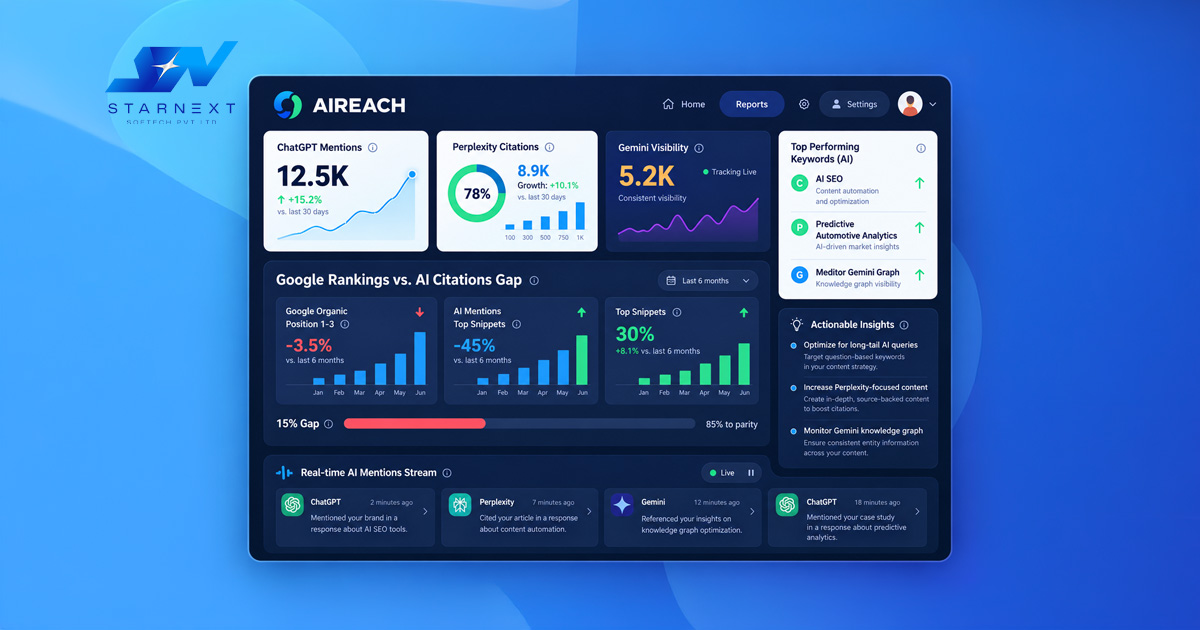
5. Track Business Results, Not Made-Up AI Rankings
AI answers change depending on who's asking, how the question is worded, where the person is, when they ask and which platform they use. Be careful of any tool that says it can guarantee a "number one AI rank" forever.
Use the generative-AI reports in Google Search Console with tools like analytics, conversion tracking, brand searches, lead quality and customer feedback. Google says to use Search Console to check how well the site is doing. Says third-party tools don't have access to its internal ranking or AI systems.
Common GEO Mistakes That Waste Time
- Thinking GEO is the same as SEO: Visibility, technical health, good content and trust in the brand are still important. GEO adds to these things.
- Creating AI-assisted content in large amounts: More pages don't make a bigger brand if the content just repeats common ideas and adds no real value.
- Writing just to be quoted: A page built to be copied but not helpful after the click might not bring business.
- Using much structured data: Schema can help explain what kind of page it is but it can't fix weak content, unclear claims or bad user experience.
- Ignoring the brand outside the website: A strong service page is not as convincing if reviews, profiles, leadership details and other mentions say something
- Mixing visibility with sales: An AI mention is not the same as a lead. Check if the traffic leads to visits, questions, bookings or sales.
The Future Favors Businesses That Are Easy to Check
AI search doesn't mean a website is no longer needed. It means the website must offer more.
As people ask complicated questions and expect answers that are put together, businesses will do better if they are easy to understand, easy to check and truly helpful when someone is making a decision. AI Overviews and AI Mode can show relevant links through query expansion, which means a smaller brand can have a chance if it gives the best proof for a specific problem, not just the biggest website.
The main idea is simple: stop thinking of SEO as a competition. Start thinking of it as a system for sharing business information. Your site, proof, reputation, product details, information and expert opinions should work together to answer the real question a customer is trying to solve.
Final Thoughts
The businesses that will do best with AI search will not be the ones chasing every term. They will be the ones that make their knowledge, offer and reputation clear enough that someone—human or AI—can confidently say why they are important.
Build the SEO basics well. Then improve the proof, clarity and originality that make a page into a source. That is the long-term way to get found in AI search no matter how the tools, models or results change.