Google My Business Listing: How to Improve Your Google Maps Rankings
For businesses serving a city or area a Google My Business Listing can sit directly between a high-intent search and the customers decision to call, visit, book or move on to a competitor.
Someone searching for "yoga teacher training in Rishikesh" usually does not want to spend twenty minutes researching for yoga courses. Someone typing "cafe nearby" is probably deciding where to go. A search for "AC repair near me" may turn into a phone call within minutes.
That is what makes local search different.
Google now officially calls the product Google Business Profile. Businesses and searchers still commonly use Google My Business or GMB. The name changed; the business opportunity did not.
The challenge is that merely creating a profile is not enough. Google says local results are primarily influenced by relevance, distance and prominence. A business therefore needs to make it easy for Google to understand what it offers while giving customers confidence to choose it.
Google Maps Rankings Are Built Around Relevance, Distance and Prominence
Before changing categories requesting reviews or uploading another batch of photographs understand what Google is actually trying to accomplish.
It wants to match each search with businesses that make sense for that particular user.
- Relevance is about how the business matches the search.
- Distance considers how far the business is from the searcher or specified location.
- Prominence reflects how established or well-known the business appears.
Google also confirms that complete business information, reviews and links to a business can contribute to visibility.
This has one implication:
You can improve relevance and prominence but you cannot completely optimize your way around geography.
A salon on one side of a city may rank strongly for searches and appear much lower when the same phrase is searched several kilometres away.
That is local-search behaviour, not necessarily an SEO failure.
Your Primary Category Helps Google Understand What Your Business Actually Is
Category selection deserves more attention than most businesses give it.
Google explicitly states that the categories selected for a Business Profile affect ranking and recommends choosing the most specific category that accurately represents the business.
Industry research also repeatedly identifies the category as one of the strongest controllable local-ranking signals.
Consider a dental clinic. Choosing a category such as the most relevant dental specialty gives Google clearer context than selecting a broad category simply because it appears popular.
Secondary categories can then describe genuine parts of the business.
The mistake is treating categories like keywords. Adding anything vaguely related. Choose the category that describes what the business is, not every service the business happens to offer.
A Complete Profile Gives Google Better Data and Customers Fewer Reasons to Leave
local listings fail at surprisingly basic things.
Google advises businesses to keep their information accurate, complete and current because complete profiles are more likely to appear for local searches.
A serious 'Google My Business Optimization' The process should therefore begin with accuracy rather than aggressive keyword placement.
The business name should reflect the real-world name. The address or service area should be correct. Hours need to match reality. Relevant attributes, services and contact details should be completed wherever applicable.
These details seem simple until a customer drives to a location marked "open". Find the shutters down.
Local SEO is partly an information problem. Better information produces a search experience.
Reviews Support Local Visibility While Doing Something More Important: Building Trust
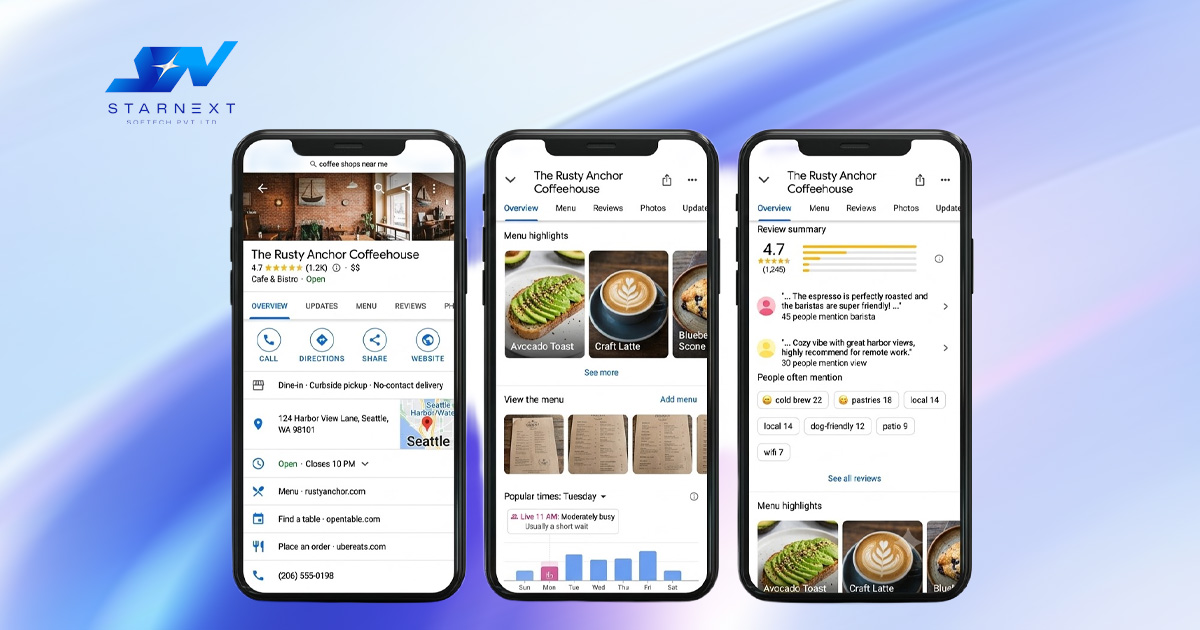
Reviews sit at the intersection of rankings and conversion.
Google states that more reviews and positive ratings can help a business's ranking. It also encourages businesses to respond to customers because responses show that feedback is valued.
Think beyond the algorithm.
Suppose two clinics appear in the Map Pack. One has reviews discussing actual treatments, helpful staff and recent patient experiences. The other has a rating but its newest review is ten months old.
Which profile gives the searcher confidence?
That is why a sustainable review strategy matters more than asking twenty customers at once.
Google allows businesses to share review links or QR codes with customers. Incentives in exchange for reviews are prohibited.
The strongest review strategy is simple: ask customers consistently to make the process easy and respond professionally.
Photos Should Answer Questions a Customer Has Before Visiting
Uploading images is useful but not because a magic number of photographs guarantees rankings.
Google recommends category- images that help customers understand a business and says photographs can help profiles stand out. It also recommends well-lit images without excessive alterations.
A restaurant should show the food, seating and entrance. A salon can show its environment and real work. A retailer can show products and the storefront. A clinic can use photographs of its reception, facilities and team.
Think about the customer opening the profile for the time.
What would they want to see before deciding to call or visit?
That question produces a better photo strategy than uploading generic stock images or obsessing over image-file SEO tricks.
Your Website Should Confirm What Your Business Profile Claims
A strong 'Google Maps SEO Strategy' does not stop inside Google Business Profile.
Google Maps SEO Strategy explains that profile information can be assembled from sources, including publicly available web content such as the business's own website.
That makes consistency important.
If a plumbing company lists boiler repair, emergency plumbing and leak detection on its profile the website should provide information about those services. A real-estate consultancy serving markets should have useful landing pages that demonstrate its involvement in those markets rather than relying on a generic homepage filled with city names.
This is where 'Google Business Profile SEO' and traditional website SEO begin to overlap.
Your website helps establish context, services, authority and the wider online identity of the business.
Google Posts Are Better Viewed as Conversion Content Than a Ranking Hack
Posts can be useful without needing to be a ranking trick.
Google allows businesses to publish updates, offers and events through their profiles on Search and Maps. These posts can provide information and help customers decide whether to engage with the business.
That makes Posts useful for a restaurant promoting a menu, a salon announcing a new treatment, a retailer sharing a collection launch or a business promoting an upcoming event.
Do not post content every day merely because someone claimed "profile activity" automatically improves rankings. Publish because the information helps a customer.
That principle keeps the content useful when a particular feature is not a confirmed ranking factor.
10 Practical Actions That Strengthen a Google My Business Listing
A 'Google My Business SEO' plan should prioritize the parts of local visibility a business can genuinely influence.
1. Correctly represent the business
Verification gives the owner control over information and is fundamental to managing visibility.
2. Choose the accurate primary category.
Truthful categorization improves Google's understanding of the business.
3. Add relevant secondary categories
Use them for additional business functions, not keyword expansion.
4. Complete essential profile information.
Check the address, service area, phone number, website, hours, attributes and services.
5. Create a consistent review process.
Ask customers regularly instead of relying on occasional review campaigns.
6.Respond to customer reviews
Useful responses strengthen the profile's reputation. Demonstrate active customer care.
7. Upload real pictures.
Show what people really need to see before they come to the business or get in touch.
8. Make the website match the profile.
Pages that're related and correct information help show the same business and what it offers.
9. Use posts when there is something to share
Announcements, events, deals and real updates can make the profile better to use.
10. Check how visible the business is in areas and how many people take action
Track calls, website visits, bookings, directions and leads—not one simple ranking check.
The Important GMB Ranking Factors Are Not All Equally Controllable
Talks about 'GMB Ranking Factors' often make it seem like every part can be changed.
That is not true.
Distance depends a lot on where the person's searching from. Businesses can't make themselves closer to every customer.
Categories, details, managing reviews, website content and being well-known are different because businesses can work on them.
That means some things should come first:
Focus on the things you can change that have the effect then look at how well the business is doing in different places instead of looking for one single position on Maps.
Current studies show that the category and other profile details are among the most important things to work on. Google's official list still includes relevance, distance and prominence.
Local SEO for Small Businesses Should Be Measured in Customers Not Just Positions
Local SEO for Small Businesses often gets too focused on whether a listing moves up one spot on the list.
Rankings are important. They are not the final goal.
A profile that has a description, good reviews, helpful pictures, correct hours and a website that shows what the business does might get more people to call or visit than a business that is higher up but has bad details.
So while looking at visibility also check what happens next:
Are people calling? Are they asking for directions? Are they checking the website? Are they booking something? Are they sending questions?
The point of being on Maps is not to have a SEO report.
It is to help the right local person find the business and choose it.
AI Search Is Making Consistent Business Information More Valuable
Local discovery is not just about the old ten blue links and the Map Pack anymore.
AI-powered search is now part of how people look for companies. Some SEO tools are already seeing AI-generated results along with local listings.
Businesses should not try to create a new "AI SEO" plan.
A better way is to make the business easy to understand on the web: details, clear website pages, real reviews, relevant mentions and the same information everywhere.
These basics help with local search and also give new search systems clear details to use.
Final Thoughts
The Best Local Optimization Makes Your Business Easier to Understand and Easier to Choose
local SEO is not about finding one small part of the Google Business Profile that others missed.
It's about making things clear.
Google should be able to understand what your business is, what it offers and where it is located. Customers should be able to see if the business is trustworthy right for them and worth contacting.
That means getting the basics right: details, the right category, real reviews, good pictures, relevant website pages and the same information everywhere.
An organized 'Google My Business Listing' will not make the business the closest one or guarantee the top spot, for every search.
What it can do is help the business show up more for the local searches—and turn that visibility into calls, visits, bookings and customers.
That is the goal of good 'Google My Business Optimization'.