Google SGE (Search Generative Experience): How to Rank in the AI Era
Search has changed. The goal of SEO has been pretty simple for years: Find a keyword, build a useful page, optimize it, build authority, and try to get to the top of Google's organic results. Then AI entered the picture. Google launched tests for the Search Generative Experience (SGE), which would eventually become the AI-powered search experiences we know today as AI Overviews and AI Mode. Google can generate an AI-generated answer, synthesize information from multiple sources, and offer links for those who want to dig deeper instead of just giving you a list of links. And that changes the SEO conversation.
The good news? SEO isn't dead. Google itself says its generative AI search features are built on core Search ranking and quality systems, meaning traditional SEO fundamentals still matter. The bigger opportunity is learning how to make those fundamentals work in an AI-driven search environment. So, if you're wondering how to rank in Google SGE, AI Overviews, or AI Mode, let's break down what actually matters and what you should be doing differently.
What Is Google SGE?
Google SGE, or Search Generative Experience, was the first name used to describe Google's experimental AI-powered search approach. It was a simple but meaningful idea: instead of making users click through multiple search results to assemble an answer, Google's AI could offer a helpful overview right within the search experience.
Now, Google's AI search ecosystem has moved past the original SGE terminology. "AI Overviews" and "AI Mode" are now the more relevant terms for understanding Google's generative search experience. Google says AI Overviews and AI Mode use AI techniques grounded in information retrieved from its search index, with links to relevant web pages included in responses.
That means your website isn't necessarily competing only for a traditional blue-link ranking anymore. You're also competing to become a source that Google's AI systems consider useful enough to reference. And that's where things get interesting.
How AI Search Is Changing SEO

Traditional search often looks something like this:
User searches → Google shows results → User clicks a page
AI-powered search can look more like this:
User asks a complex question → Google retrieves relevant information → AI synthesizes an answer → User explores selected sources
Google says people are increasingly asking longer, more specific, and more complex questions in its AI search experiences. AI Mode, in particular, is designed around deeper, conversational searches and uses a technique called query fan-out to explore related subtopics.
For marketers, that means that keyword targeting is not enough. You are going to learn about search intent, context, entities, related questions, and the broad topic. In other words, don't just optimize a page for one keyword. Build a resource that genuinely answers the question.
1. Create Original, Helpful Content
Let's start with the most important point. Don't create content simply because you want to rank. Create content because someone needs it. Google's current guidance for AI search repeatedly emphasizes unique, valuable, people-first content. It specifically recommends creating content that isn't just generic or interchangeable with thousands of other pages.
This is especially important in the AI era. If your article says exactly what every other article says, why should Google's systems or your readers choose it? Instead, add something original. That could mean:
- First-hand experience
- Original research
- Expert opinions
- Case studies
- Real examples
- Unique data
- Product testing
- Customer insights
- Expert interviews
- Original images or videos
For example, don't write another generic article titled "How to Improve Your Website SEO." Instead, explain what you actually did on a website, what changed, what worked, what didn't, and what you learned. That's much harder to replicate and far more useful.
2. Optimize for Search Intent, Not Just Keywords
Keyword stuffing has never been a good SEO strategy. In AI search, it makes even less sense.
Imagine someone searches: "How can a small business reduce its Google Ads costs?"
They probably don't want a 1,500-word article that repeats "reduce Google Ads costs" 25 times. They want practical answers. Maybe they want to understand quality score, negative keywords, conversion tracking, bidding strategies, landing pages, and campaign structure. Your job is to anticipate those needs.
A strong AI search optimization strategy therefore starts with understanding the complete intent behind a query. Ask:
- What does the user actually want?
- What follow-up questions might they have?
- What information would help them make a decision?
- What examples would make the answer clearer?
- What could a competitor's generic article be missing?
This approach helps you create content that satisfies users rather than simply matching search terms.
3. Build Topic Authority
One page rarely establishes a brand as an expert. If you want your website to become a reliable source in a particular niche, build a network of related content. For example, suppose you run a digital marketing agency. Instead of publishing one article about SEO, you could create a comprehensive content cluster covering:
- Technical SEO
- Local SEO
- E-commerce SEO
- Keyword research
- On-page SEO
- Link building
- SEO analytics
- Content strategy
- SEO audits
- AI search optimization
Then connect these pages through thoughtful internal links. This helps users discover related information and gives search engines a clearer understanding of your website's expertise. The goal isn't to publish hundreds of thin articles. It's to build depth around topics that matter to your audience.
4. Strengthen E-E-A-T Signals
You may have heard of Google's E-E-A-T framework: Experience, Expertise, Authoritativeness, and Trustworthiness. While E-E-A-T isn't a single ranking factor you can "turn on," these concepts are important when creating content people can trust. In the AI era, they become even more valuable. Why? Because generic information is becoming incredibly easy to produce. What remains difficult to fake convincingly is genuine experience.
If you're writing about accounting, show expertise. If you're reviewing a product, demonstrate that it was actually tested. If you're giving business advice, support your recommendations with evidence and real examples. Make your authors identifiable where appropriate. Explain credentials when they genuinely matter. Cite reliable sources. Keep important information accurate and updated. In short, give readers a reason to trust you.
5. Make Your Content Easy for AI and Humans to Understand
You don't need to write for robots. You need to write clearly for people. Fortunately, what helps humans often helps search systems too. Use:
- Clear headings
- Short paragraphs
- Descriptive subheadings
- Bullet points
- Tables where useful
- Definitions
- Examples
- Logical page structures
- Descriptive links
Answer important questions directly. If you're explaining "What is technical SEO?" don't spend five paragraphs building suspense. Say what it is. Then explain it. Google's current guidance also tells you to use semantic HTML when you can and maintain a good page experience but also notes that you don't need to obsess over perfect code.
6. Don't Ignore Technical SEO
AI search may sound futuristic, but websites still need to follow basic technical SEO principles. Google needs to be able to access, crawl, and index your content. That means checking things such as:
- Robots.txt configuration
- Indexing issues
- HTTP status codes
- Internal links
- Canonical tags
- Mobile usability
- Page speed
- JavaScript rendering
- Duplicate content
- XML sitemaps
Google's guidance is clear: if your content isn't accessible and indexable, it has little chance of being considered for search features, including generative AI experiences. So before chasing advanced GEO or AEO strategies, make sure your basic SEO foundation isn't broken.
7. Use Images, Videos, and Other Formats
AI search isn't limited to text. Google's current guidance specifically encourages site owners to support textual content with high-quality images and videos, particularly as Search becomes more multimodal. That's a useful reminder: your website should provide information in the formats your audience actually finds helpful.
For example, a home improvement company could publish:
- Written tutorials
- Original project photos
- Instructional videos
- Diagrams
- Before-and-after images
An e-commerce brand could provide:
- Product videos
- Demonstrations
- Size guides
- Comparison charts
- Original product photography
Don't add visuals simply to check an SEO box. Use them to make the content better.
8. Optimize Structured Data Correctly
Structured data helps search engines understand information on your web pages and can also make your content eligible for special search result features. But there is an important rule: your structured data has to match the information on the page. Google specifically tells site owners to ensure that their structured data matches the visible content and to adhere to the applicable guidelines.
So don't use schema markup to claim information that isn't actually on the page for users to find. Think of structured data as a way of communicating clearly with search engines, not a shortcut around quality content.
9. Create Content That Deserves to Be Cited
This may be the biggest mindset shift in SEO for AI search. Instead of asking: "How do I rank number one?" Start asking: "Why would an AI system want to cite my page?"
"Don't just ask how to rank number one. Ask why an AI system would want to cite your page."
That question changes how you create content. A page is more useful as a potential source when it contains clear, trustworthy, relevant, original information. For example, an article that says: "SEO is important for businesses," isn't particularly distinctive. But an article that includes original research, specific statistics, expert commentary, examples, methodology, and practical recommendations gives search systems much more useful material to work with.
Google has also emphasized opportunities for original content and firsthand perspectives in AI Search, including new features designed to help users discover original and influential sources.
10. Measure More Than Traditional Rankings
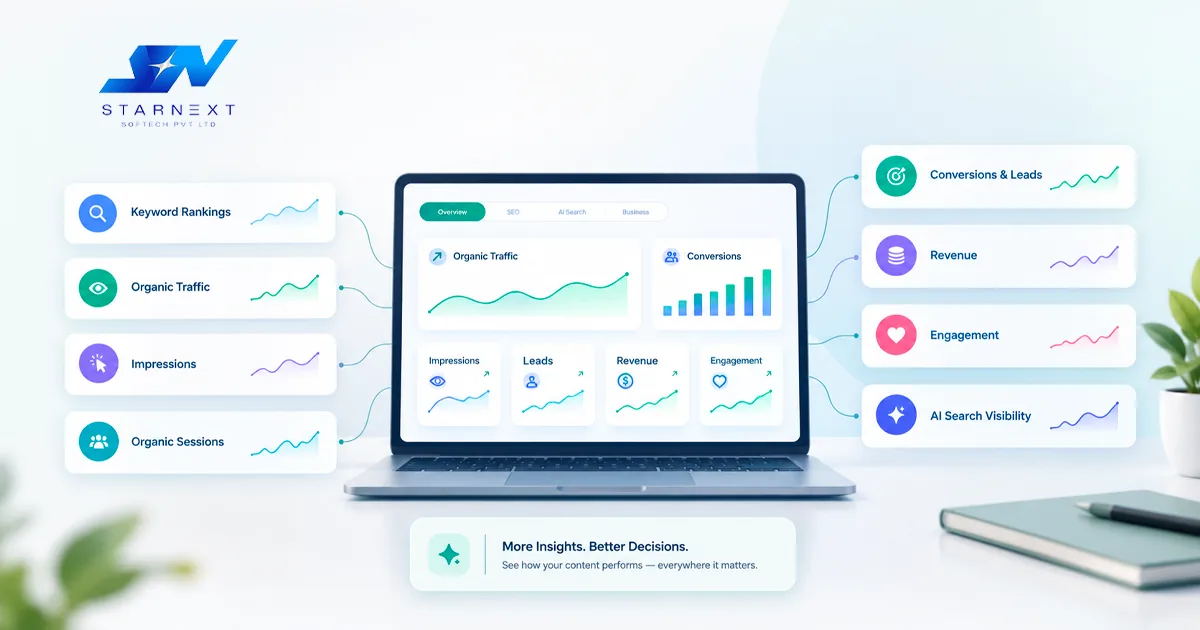
AI search also changes how you think about SEO performance. A traditional SEO report might focus on:
- Keyword rankings
- Organic clicks
- Impressions
- Organic sessions
Those metrics still matter. But they're not the whole picture. You should also pay attention to:
- Organic conversions
- Leads
- Revenue
- Engagement
- Branded searches
- Assisted conversions
- Visibility in AI search experiences
- Which pages attract qualified visitors
Google began rolling out dedicated Search Generative AI performance reports in Search Console in June 2026, providing visibility into impressions from generative AI features such as AI Overviews and AI Mode for a subset of sites. As these measurement capabilities expand, SEO teams will have more ways to understand how their content performs across traditional and AI-powered Search.
What About AEO and GEO?
You've probably seen terms like AEO (Answer Engine Optimization) and GEO (Generative Engine Optimization) everywhere lately. They're useful terms for describing efforts to improve visibility in AI-powered search and answer experiences. But don't fall into the trap of thinking they replace SEO.
Google's own documentation says that, from its perspective, optimizing for generative AI search is still SEO because its AI search features rely on core Search systems and SEO best practices. So you don't need a completely separate "AI SEO" playbook. You need better SEO. Better content. Better technical foundations. Better expertise. Better user experiences. And more original value.
Also Read: How to Grow Your Business Digitally in 2026
Should You Use AI to Create SEO Content?
Yes - but carefully. AI tools can help with researching, brainstorming, outlining, editing, and organizing your ideas. The issue is when companies employ AI to vomit out hundreds of pages with little originality or value. Google clearly warns that creating lots of AI-generated pages without much value can break their spam policies around scaled content abuse.
So use AI as a tool - not as a replacement for expertise. Add human review. Fact-check important claims. Include original insights. Bring in firsthand experience. Make sure the final piece actually helps someone.
A Practical Google SGE SEO Checklist for 2026
If you're wondering where to start, here's a simple checklist:
- 1. Audit your technical SEO: Make sure Google can crawl and index your important pages.
- 2. Review your existing content: Remove, improve, consolidate, or update weak pages.
- 3. Focus on search intent: Answer the actual question behind the query.
- 4. Build topic clusters: Develop depth around your most important subjects.
- 5. Add original value: Use research, examples, data, expertise, and firsthand experience.
- 6. Strengthen E-E-A-T: Demonstrate why your brand and authors are trustworthy sources.
- 7. Improve page experience: Make content fast, readable, mobile-friendly, and easy to navigate.
- 8. Use multimedia: Add useful original images, videos, and other formats where appropriate.
- 9. Implement structured data accurately: Ensure your markup reflects visible page content.
- 10. Track business outcomes: Measure leads, sales, engagement, and search visibility, not rankings alone.
Final Thoughts
The rise of Google SGE, AI Overviews, and AI Mode doesn't mean SEO is becoming irrelevant. If anything, it raises the bar. Google's AI search systems still depend on information from the web, and Google's own guidance continues to emphasize crawlability, strong technical foundations, useful content, originality, and people-first experiences. The brands most likely to benefit won't be the ones desperately trying to find an "AI ranking hack." They'll be the ones creating information worth discovering.
So, don't obsess over writing for AI. Write for people first. Answer difficult questions. Share real expertise. Provide original information. Make your pages easy to understand. Keep your website technically healthy. If you do those things consistently, you're not just preparing for Google's AI search. You're building a stronger website for the future of search itself.